提交
参加本活动需要一个免费的 IAAP 账户。入选和奖项随后会汇集在个人资料中。
规则
组织者
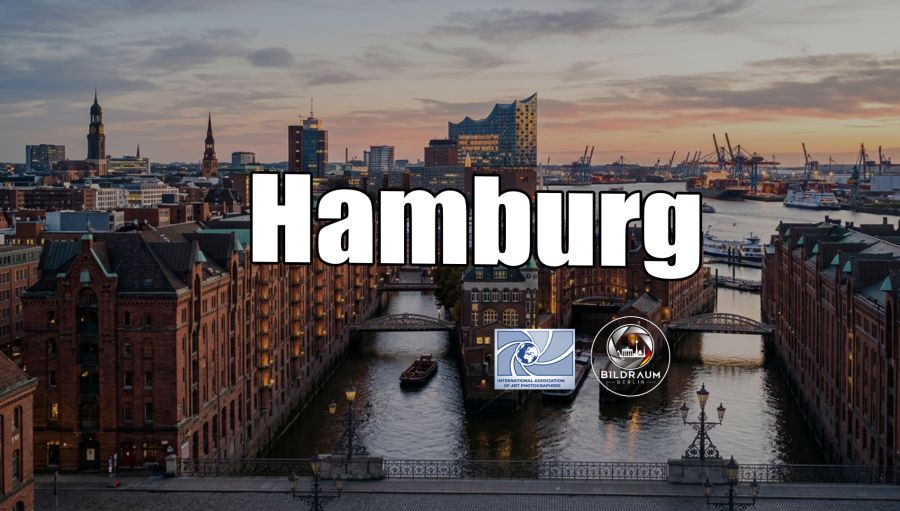
HAMBURG is international contest of art photography, organized by Stefania Padovani from Berlin, Germany.
组别
The contest is divided into the following sections:
• Open Color
• Minimalism
• Street Photography
• Emotion
• Open Mono
• Nature
• Photojournalism
• Travel
• Portrait
• Nude
• Architecture
• Creative
• Open Color
• Minimalism
• Street Photography
• Emotion
• Open Mono
• Nature
• Photojournalism
• Travel
• Portrait
• Nude
• Architecture
• Creative
日历
Closing date: November 22, 2026
Judging date: November 29, 2026
Notification date: December 13, 2026
Delivery date: January 10, 2027
Gallery publish date: January 10, 2027
Judging date: November 29, 2026
Notification date: December 13, 2026
Delivery date: January 10, 2027
Gallery publish date: January 10, 2027
支付
The entry fee depends on the number of sections the participant enters. The fees are as follows:
• 1-3 sections = 6 EUR
• 4-6 sections = 10 EUR
• 7-9 sections = 15 EUR
• 10-12 sections = 20 EUR
The entry fee can be paid in the following ways:
• through our website: https://theiaap.com/e/hamburg
• PAYPAL ACCOUNT: [email protected]
Images from participants who have not paid the entry fee will not be considered.
评审团
• Gottfried Catania; AFIAP EPSA GPU CR5 VIP4 c*MOL IIG/s8 BAPU E.APS/S GM.SSP GM.NPS E.CPE ES.CPE Hon.CPE Hon.WPAI HonJSP (Malta)
• Irene Ehrenreich; MPSA 2, EFIAP/G, GPU CR3, GPU VIP4 (Austria)
• Barun Dey; GM IAAP, GPU CR-4, GPU VIP-4, EPSA, AFIAP, C MoL, GMPBA, GM.APS, EFIP, E.NPS, A FPO, SWPU/1, Hon. CPE (India)
• Irene Ehrenreich; MPSA 2, EFIAP/G, GPU CR3, GPU VIP4 (Austria)
• Barun Dey; GM IAAP, GPU CR-4, GPU VIP-4, EPSA, AFIAP, C MoL, GMPBA, GM.APS, EFIP, E.NPS, A FPO, SWPU/1, Hon. CPE (India)
奖励
The judges of the event will present the following awards:
12 x IAAP Gold E-Certificate, 12 x IAAP Silver E-Certificate, 12 x IAAP Bronze E-Certificate, 36 x IAAP Honorable Mention E-Certificate
12 x BILDRAUM Gold E-Certificate, 12 x BILDRAUM Silver E-Certificate, 12 x BILDRAUM Bronze E-Certificate, 36 x BILDRAUM Honorable Mention E-Certificate
12 x SALON Gold E-Certificate, 12 x SALON Silver E-Certificate, 12 x SALON Bronze E-Certificate, 36 x SALON Honorable Mention E-Certificate
Total 216 awards. The organizer reserves the right to adjust the number of awards based on the total number of entrants.
定义
All entries shall conform to the stricter of these definitions for acceptances to be validated by all the international organizations granting recognition or patronage.
[General conditions]
● Every image is the work of the author, made from the author's own photographs.
● A section accepts both colour and monochrome work unless its name or the rules of the event say otherwise.
● Unless the definition restricts it, post-processing is free, but the subject must remain recognisable as the stated theme.
● Where a section is also entered as a FIAP or PSA division, the FIAP or PSA definition prevails over the text given here.
● Whether an image meets the theme is decided by the judges. An image outside the theme may be rejected before judging or left unscored, and the rules of the event say which of the two happens.
● An organizer may narrow a definition and must then publish the narrowing. An organizer may not widen one while keeping the standard section name.
● Images generated wholly or partly by generative artificial intelligence are not photographs and are not eligible in any section defined here.
[IAAP · Monochrome]
Black and white photography is an image that displays a range of shades from black to white, encompassing various tones of gray. Such an image focuses on the nuances of light, shadow, and contrast without incorporating any colors. If the entire image is toned in a single hue, it remains within the black and white category. However, if it is modified by partial toning or the addition of any color, it becomes a color work and no longer qualifies as a black and white photograph.
[IAAP · Nature]
A nature photograph records all aspects of the natural world, both animate and inanimate. The primary subject of a nature photograph should be animals and elements of nature, though human and human-made elements are allowed as long as they do not dominate the scene. The image must convey the truth of the scene and be presented honestly, without unethical practices to manipulate the subject or setting. High technical standards are expected, and the photograph should look natural. Human activity or objects are permissible only if they are a necessary part of the nature story being told.
[IAAP · Photojournalism]
A photojournalism photograph is an image that captures a moment or event in a way that tells a factual story, intended to inform and convey truth to the public. It should document real events, people, and places without staging or manipulation, ensuring the authenticity of the scene. The primary aim is to provide an accurate and unbiased representation of the subject matter, often related to news, social issues, cultural events, or significant moments in history. Ethical standards are crucial in photojournalism, prohibiting any alterations that could mislead the viewer or distort the reality of the captured moment.
[IAAP · Travel]
A travel photograph captures the essence of a location, conveying the unique character and atmosphere of a place. It should reflect the natural beauty, cultural heritage, and distinctive features of the destination, providing viewers with a sense of the location identity and spirit. Travel photography encompasses a wide range of subjects, including landscapes, cityscapes, seascapes, architecture, people, and customs, all of which contribute to the overall experience of the destination. The primary goal is to transport viewers to the location through the image, allowing them to explore and appreciate the worlds diverse cultures and environments.
[Standard section definitions]
[Portrait]
Portrait photography focuses on a person or a small group, with particular attention to the face, gaze, expression or character. The people portrayed must be the main subject and shown as individuals, rather than simply as figures within a scene. Posed and candid portraits are equally welcome, including self-portraits and head-and-shoulders, three-quarter or full-length views. Environmental portraits are also accepted when the surroundings help convey the subject's character. Images in which people are incidental to a landscape, street scene or architectural study do not qualify. Neither do crowds without an identifiable subject or abstract studies that do not portray an individual.
[Architecture]
Architectural photography focuses on a built structure or part of one, showing its form, construction, surface, geometry or function. Both interiors and exteriors are accepted, regardless of the structure's age or condition. Subjects may include complete buildings, individual features, bridges, towers, engineering works, construction sites and ruins. Architectural details and abstract images derived from built forms are also welcome. A broad city view without a dominant structure belongs in Cityscape. A street scene centred on people belongs in Street Photography. Neither falls within the Architecture section.
[Street Photography]
Street Photography records life as it happens in public places. Photographs must be candid, without staging or directing the scene. The subject may be an incident, a gesture, a relationship between elements, or the atmosphere of a public space. Accepted settings include streets, markets, public transport and public events. Observed urban details and images without people are also welcome when the street itself provides the subject. The section follows a documentary approach. Staged, directed or re-enacted scenes and studio photographs are not accepted. Adding or removing significant elements, or combining them from different frames, is not permitted. Tone, contrast, colour and cropping may be adjusted freely.
[Minimalism]
Minimalist photography creates a strong image from very few elements. Simplicity, open areas and negative space are central to the composition. A single shape, a line or a small area of colour against an uncluttered background may provide the subject. The essential requirement is deliberate visual reduction, whether found in the scene or achieved through framing. Accepted approaches include a single subject against a plain background, high-key or low-key treatments, and the graphic simplification of a larger scene. Busy or crowded compositions do not qualify. An ordinary record of a scene, without this reduction to essentials, is not enough.
[Nude]
Nude photography explores the unclothed or partly unclothed human body through form, line, light or expression. Full and partial nudes are accepted, including classical and contemporary figure studies, abstract studies of the body, and images that treat the body as a form or landscape. Photographs may be made in a studio, an interior or a natural setting. Every person shown must be an adult who has consented both to being photographed and to the image being exhibited. The author must be able to confirm this on request. Pornographic, sexually explicit or otherwise offensive images are not accepted. Any depiction of a person under eighteen years of age is not eligible in this or in any other section.
[Emotion]
The Emotion section focuses on a feeling that is clearly expressed through a face, a gesture or a situation. Subjects may convey joy, grief, fear, tenderness, anger, boredom or solitude. Portraits and candid photographs are accepted, as are scenes whose arrangement communicates the feeling. Emotion in animals may be included when the event allows it. The emotional content must be evident in the photograph itself. A neutral portrait without emotional content, or an image whose connection to the theme depends only on its title, does not qualify.
[Creative]
Creative photography presents an imaginative image rather than a straightforward record of a scene. The photograph must be visibly altered, constructed or combined so that its departure from reality is clear. Accepted approaches include montage, composites, multiple exposures, digital manipulation, texture overlays, strong toning, intentional camera movement, infrared and alternative photographic processes. Conceptual or surreal scenes staged for the camera are also welcome. Every element of the finished image must originate in a photograph taken by the author. Straight, unaltered photographs do not qualify, and applying a preset or filter alone is not enough. Images generated wholly or partly by generative artificial intelligence are not photographs and are not eligible.
联系
日历
最后一天
评审日
通知日
目录交付
概览
参与者
16
照片
401
国家
11
支付
6 EUR
所有IAAP成员可享受50%的折扣
奖励
奖励
216
文凭
108
赞助人数
 IAAP
 BILDRAUM
IAAP
BILDRAUM
组别
Open Color
Open Mono
Nature
Photojournalism
Travel
Portrait
Nude
Architecture
Creative
Minimalism
Street Photography
Emotion
评审团