BEKÜLDÉS
Az eseményen való részvételhez ingyenes IAAP-fiók kell. Az elfogadások és a díjak ezután a profilon gyűlnek.
SZABÁLYOK
SZERVEZŐ
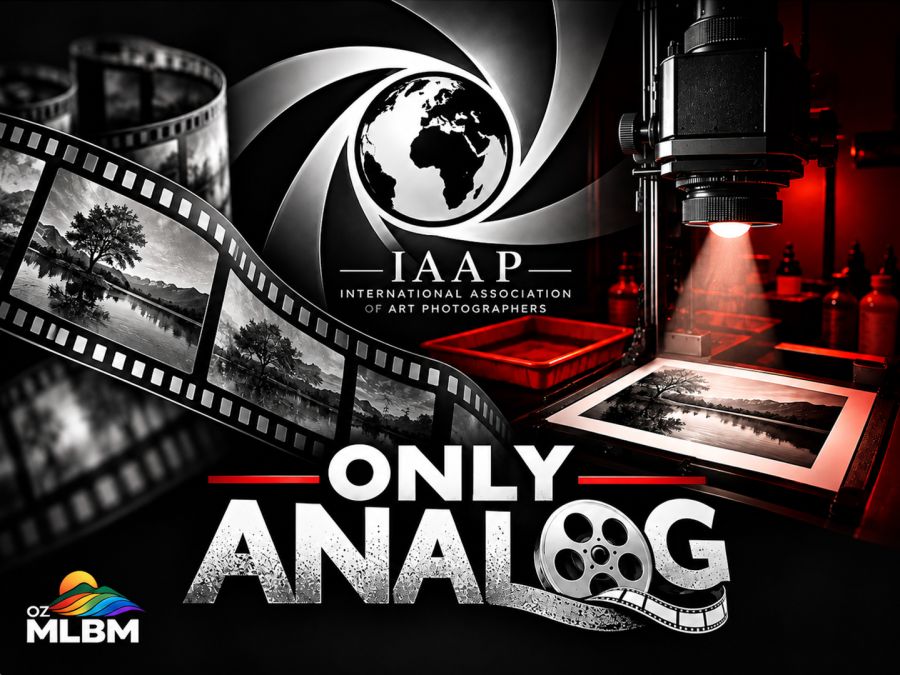
ONLY ANALOG is international contest of art photography, organized by OZ MLBM from Mala Lehota, Slovakia.
SZEKCIÓK
The contest is divided into the following sections:
• ANALOGUE PHOTOGRAPHY – (MANDATORY)
• PHOTOGRAPHED FILM NEGATIVE – PROOF (MANDATORY)
• BEHIND THE ANALOG PROCESS – (OPTIONAL)
• MY ANALOG EQUIPMENT – (OPTIONAL)
• ANALOGUE PHOTOGRAPHY – (MANDATORY)
• PHOTOGRAPHED FILM NEGATIVE – PROOF (MANDATORY)
• BEHIND THE ANALOG PROCESS – (OPTIONAL)
• MY ANALOG EQUIPMENT – (OPTIONAL)
RÉSZVÉTELI DÍJ
Entry is free of charge. No entry fee required.
RÉSZVÉTEL
The contest is open to anyone (amateur and professional photographers from all over the world); however, an entry may be rejected when the sponsoring organization or its agent, in its reasonable discretion, believes the entry does not conform to the contest rules and conditions.
Entries must originate as photographs (image-captures of objects via light sensitivity) made by the entrant on photographic emulsion or acquired digitally. By virtue of submitting an entry, the entrant certifies the image as his own (aliases are not permitted). The entrant permits the sponsors to reproduce all or part of the entered material free of charge for publication and/or display in media related to the exhibition. This may include low resolution posting on a website. Note: Entrants who indicate that their images may not be reproduced or used 'will not be eligible for awards' or inclusion in audio-visuals of the exhibition 'and could be subject to disqualification' by the exhibition sponsors.
By submitting an entry, the entrant certifies legal Age, and own all rights to these images, including copyright or parents or guardians gives permission on his/her behalf if he/she is not of Legal Age. The exhibition assumes no liability of any misuse of copyright. Images may be altered, either electronically or otherwise, by the maker. All final image must be on photographic film, or on electronic file, or on photographic or electronic print material, mounting excepted.
No title or identification of the maker shall be visible anywhere on the face of an image, print mat or mount.
BEKÜLDÉS
Photographs must be in JPEG format, with dimensions 1920x1080 pixels at 300, JPEG compression (if Photoshop used for export): 7-12, file size maximum 4 Mb. Each image must have a unique title. Titles must not include file extensions such as .jpg or .jpeg (or any other camera capture filenames). No title or identification of the maker shall be written anywhere on the face of an image.
The photographs of participants with the application are submitted in these ways:
- uploading thought our website:
- by e-mail: [email protected]
The photographs of participants with the application are submitted in these ways:
- uploading thought our website:
- by e-mail: [email protected]
AZONOSÍTÁS
The judging will be done by remote online judging. All judges will be using equipment capable of displaying images at 100% of the image resolution. Judges will be using color calibrated equipment. Target Range will be max 30%.
ADATVÉDELEM
By entering this contest, the participant explicitly consents to the personal details supplied, including physical addresses and email addresses, being held, processed and used by the contest organizers for purposes associated with this contest. The participant also explicitly consents to such information being sent to organizations that have accorded official recognition, patronage or accreditation to this contest. The participant acknowledges, agrees and accepts that by entering this contest, their participation status, which includes first and last name, name of the country used during registration at the contest, number of sections entered and number of photos entered in those sections, will be made public in a published status list, and that the results of the entry shall be made public in the exhibition gallery and the exhibition catalog.
A SZABÁLYOK MEGSÉRTÉSE
ONLY ANALOG – International Analog Photography Competition
Organizer: OZ Malá Lehota Biele More (OZ MLBM), Slovakia
Supported by: IAAP – International Association of Art Photographers
Participation: FREE OF CHARGE
ABOUT THE COMPETITION
ONLY ANALOG is an international photography competition established with the support of IAAP to preserve and promote traditional analog photography. In the age of digital technologies and artificial intelligence, we aim to highlight the unique value of photographic film, traditional photographic techniques, darkroom craftsmanship, and artistic creativity. Thanks to the support of IAAP, participation is completely free for photographers from around the world.
1. ANALOGUE PHOTOGRAPHY – COMPETITION SECTION
Only photographs created using an analog camera on black-and-white negative film, color negative film, or reversal film (slides) are eligible. The entire creative process must be analog, from capturing the image on film and its chemical development to producing the final photograph using traditional photographic methods. In the case of reversal film, the developed slide itself is considered the final photographic image. Traditional analog darkroom techniques are permitted, including dodging and burning, local lightening and darkening, contrast and exposure adjustments, toning, and traditional hand retouching of photographic prints. Photographers may use their hands, masks, and other tools during enlargement to control the amount of light reaching the photographic paper. Such techniques may alter the brightness, contrast, tonal values, and overall artistic appearance of the final photograph and are considered a natural part of analog photography. Digital manipulation of the photographic image is strictly prohibited. Digital retouching, adding or removing objects, digital compositing, digital filters, and the use of artificial intelligence are not permitted. Photographs taken with digital cameras and subsequently edited to imitate analog photography are also prohibited. The final photograph must be produced through a traditional analog process. Only afterward may it be scanned or digitally photographed for electronic submission. Scanning a negative and subsequently creating or editing the final photograph digitally is not permitted. The digital reproduction must faithfully represent the final analog artwork, including all modifications made using traditional analog techniques. Therefore, the final photograph does not have to be visually or tonally identical to the original negative. Historical analog photographs are also eligible, regardless of the year they were taken, provided that the author possesses the original negative or slide and can verify its authenticity. Each photographer may submit up to 8 photographs, uploaded to positions 1–8 in the first section.
2. PHOTOGRAPHED FILM NEGATIVE – MANDATORY AUTHENTICITY VERIFICATION
The second section is intended exclusively to verify the analog origin of the submitted photographs. It is not a separate competition category and will not be evaluated by the jury. Each participant must upload verification photographs of the original negatives or slides, photographed against a light source so that the original image is clearly visible, including the film edges, perforations, and any manufacturer markings. These elements must be visible whenever they are present on the film material used. The number of verification photographs must match the number of competition photographs submitted. Their order must correspond exactly to the first section: photograph No. 1 – negative No. 1, photograph No. 2 – negative No. 2, and so on, up to No. 8. Each verification photograph must show the entire corresponding film frame, including its boundaries. During verification, it will be taken into account that the final photograph may have been artistically modified using traditional analog techniques and therefore may not be identical to the original negative. The organizer reserves the right to request additional proof of analog origin, including further photographs of the film strip, the original negative, slide, or photographic print. If authenticity cannot be sufficiently verified, digital manipulation is detected, or any other competition rule is violated, the photograph may be disqualified, even after judging and the announcement of results.
3. BEHIND THE ANALOG PROCESS – OPTIONAL DOCUMENTATION OF THE CREATIVE PROCESS
The third section is intended for voluntary documentation of the creation of photographs submitted to the first section of the ONLY ANALOG competition. Participants may upload photographs showing various stages of creating their competition entries, such as shooting with an analog camera, developing film, working in the darkroom, enlarging photographs, or watching an image appear in the developer tray. The photographer may also appear in these documentary images. Documentation photographs may be taken using an analog camera, digital camera, or mobile phone. However, they must show the actual process of creating photographs submitted to the first section. AI-generated images or staged photographs that falsely represent the creation of a competition entry are not permitted. Participation in this section is optional. These photographs will not be judged by the jury, and no awards will be given.
4. MY ANALOG EQUIPMENT – OPTIONAL PRESENTATION OF EQUIPMENT AND MATERIALS
The fourth section is intended for the voluntary presentation of photographic equipment, materials, and techniques used to create photographs submitted to the first section of the ONLY ANALOG competition. Participants may upload photographs of the analog cameras, lenses, films, negatives, slides, photographic papers, developers, chemicals, enlargers, and other equipment actually used to create their competition entries. Technical information is also welcome, such as camera and lens models, aperture settings, shutter speeds, film sensitivity (ISO), types of photographic paper, developers, or chemical processing methods. Participants may write these details on a piece of paper and place it next to their photographic equipment or materials so that the information is visible directly in the documentary photograph. The method of presentation is left to the photographer’s creativity. Photographs in this section may be taken using an analog camera, digital camera, or mobile phone. All equipment, materials, and information shown must be directly related to the photographs submitted to the first competition section. Participation in this section is optional. These photographs will not be judged by the jury, and no awards will be given.
5. JUDGING AND COPYRIGHT
The international jury will evaluate only photographs submitted to the first section, based on artistic merit, originality, composition, technical mastery of the analog process, and overall visual impact. The second, third, and fourth sections will not be subject to artistic judging. Each participant must be the author of the competition photographs and hold the relevant copyrights. For documentary photographs submitted to the third and fourth sections, participants must have the necessary rights to submit them and authorize their use under these rules. All copyrights remain with their respective owners. By participating in the competition, the author grants the organizer a non-exclusive, royalty-free license to use the submitted photographs solely for promoting the ONLY ANALOG competition, presenting results, exhibitions, catalogs, and other non-commercial activities directly related to the competition. The author’s name will be credited whenever the publication format allows. The organizer may not sell the photographs or provide them to third parties for commercial use without the copyright holder’s consent. By entering the competition, participants confirm the accuracy of the information provided, the analog origin of their competition photographs, and their agreement with these rules.
ONLY ANALOG – Back to the Roots of Photography.
Ján Šranko – Competition Organizer, OZ Malá Lehota Biele More, Slovakia
ZSŰRI
• Vladimir Jovanovski; M NPUM; MPSA; RISF5; GPU CR3 Hermes (North Macedonia)
• Adela Rusu; EFIAP/d2, EPSA, MAAFR (Romania)
• Florentino Molero Guterrez; GMPSA/G, EFIAP/D1, ESFIAP, PFIAP, GPU CR5_VIP5, EFIP/Gold*, I.APS/b, MCEF/b, MFAF/B, MCAS, FAPU, GAPU, c***MoL, R-ISF10, ED-ISF, EH.ISF, ER.ISF, HON F.NOBEL/Grand Master, HON.CPE, E.HPS, E.GGC, ESSP (Spain)
• Matthias Haug; (Germany)
• Hanna Nevreva; (USA)
• Elina Garipova; EFIAP/b (Russia)
MEGHATÁROZÁSOK
All entries shall conform to the stricter of these definitions for acceptances to be validated by all the international organizations granting recognition or patronage.
[IAAP Definition of Monochrome]
Black and white photography is an image that displays a range of shades from black to white, encompassing various tones of gray. Such an image focuses on the nuances of light, shadow, and contrast without incorporating any colors. If the entire image is toned in a single hue, it remains within the black and white category. However, if it is modified by partial toning or the addition of any color, it becomes a color work and no longer qualifies as a black and white photograph.
KAPCSOLAT
OZ MLBM Sranko, GM IAAP, EFIAP/s , MZSF, E PIPC,
Mala Lehota, Slovakia
email: [email protected]
website: https://theiaap.com/e/onlyanalog
Mala Lehota, Slovakia
email: [email protected]
website: https://theiaap.com/e/onlyanalog
NAPTÁR
zárás
zsűrizés
értesítés
kiszállítás
ÁTTEKINTÉS
részvételi díj
ingyenes esemény
DÍJAK
díjak
36
szalagok
24
ELISMERÉSI SZÁM
 IAAP
IAAP
SZEKCIÓK
Analogue Photography – Mandatory
Photographed Film Negative – Proof Mandatory
Behind The Analog Process – Optional
My Analog Equipment – Optional
ZSŰRI
VJ
![]()
Vladimir Jovanovski
EJ IAAP
North Macedonia
AR
![]()
Adela Rusu
CJ IAAP
Romania
FM
![]()
Florentino Molero Guterrez
CJ IAAP
Spain
MH
![]()
Matthias Haug
CJ IAAP
Germany
HN
![]()
Hanna Nevreva
CJ IAAP
USA
EG
![]()
Elina Garipova
CJ IAAP
Russia